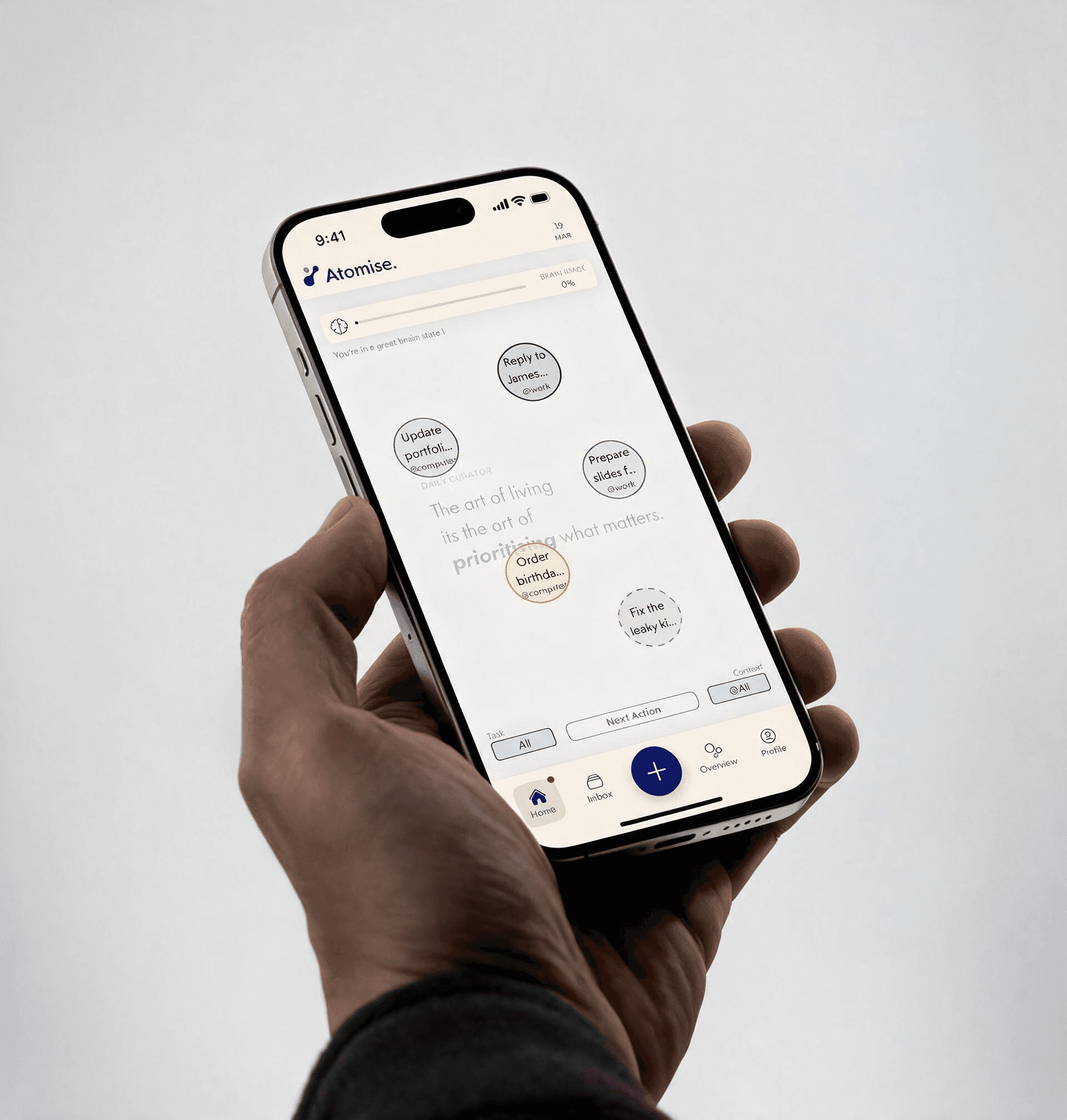
This design applies the Getting Things Done (GTD) method to offload mental anxiety and clarify task values. Contextual scheduling ensures focus and efficiency, ultimately empowering users to tackle real-world tasks confidently.
Timeline
2025.03-2025.05
Role
UI/UE Designer

Project Overview
In the digital age, users constantly face overwhelming multitasking pressure and fragmented information. Unfortunately, current time management applications often suffer from complex interactions and rigid feedback mechanisms. Instead of alleviating stress, using these apps to record tasks and schedules consumes the users' already depleted cognitive capacity, compounding their real-world burdens. This negative experience ultimately decreases productivity and leads to a loss of user retention over time.
Challenge
How might we design a low-friction task management experience that minimizes user resistance through lightweight interactions like gestures and voice inputs? Furthermore, how can we replace rigid traditional schedules with a flexible, context-based decision support system using energy and time tags, while incorporating explicit positive feedback mechanisms to alleviate user anxiety caused by visual clutter and unfinished tasks?


Results
The design achieves effortless task recording through lightweight interactions that minimize cognitive load, while context-filtered displays eliminate visual clutter to significantly reduce user anxiety and maintain focus.
Increase in Adaptive Control
Increase in Habit Building

